The test this week went okay. I felt like I pretty much knew what would be on the test. I find Chapter 10 pretty easy to grasp as math is always easier for me to understand rather than concepts. I think it would have made more sense to study stars in this depth at the beginning of the quarter when we began looking at constellations and the celestial sphere. I unfortunately had to miss the lab on Friday but I have done it myself and didn’t have any difficulty with it.
Sunday, November 14, 2010

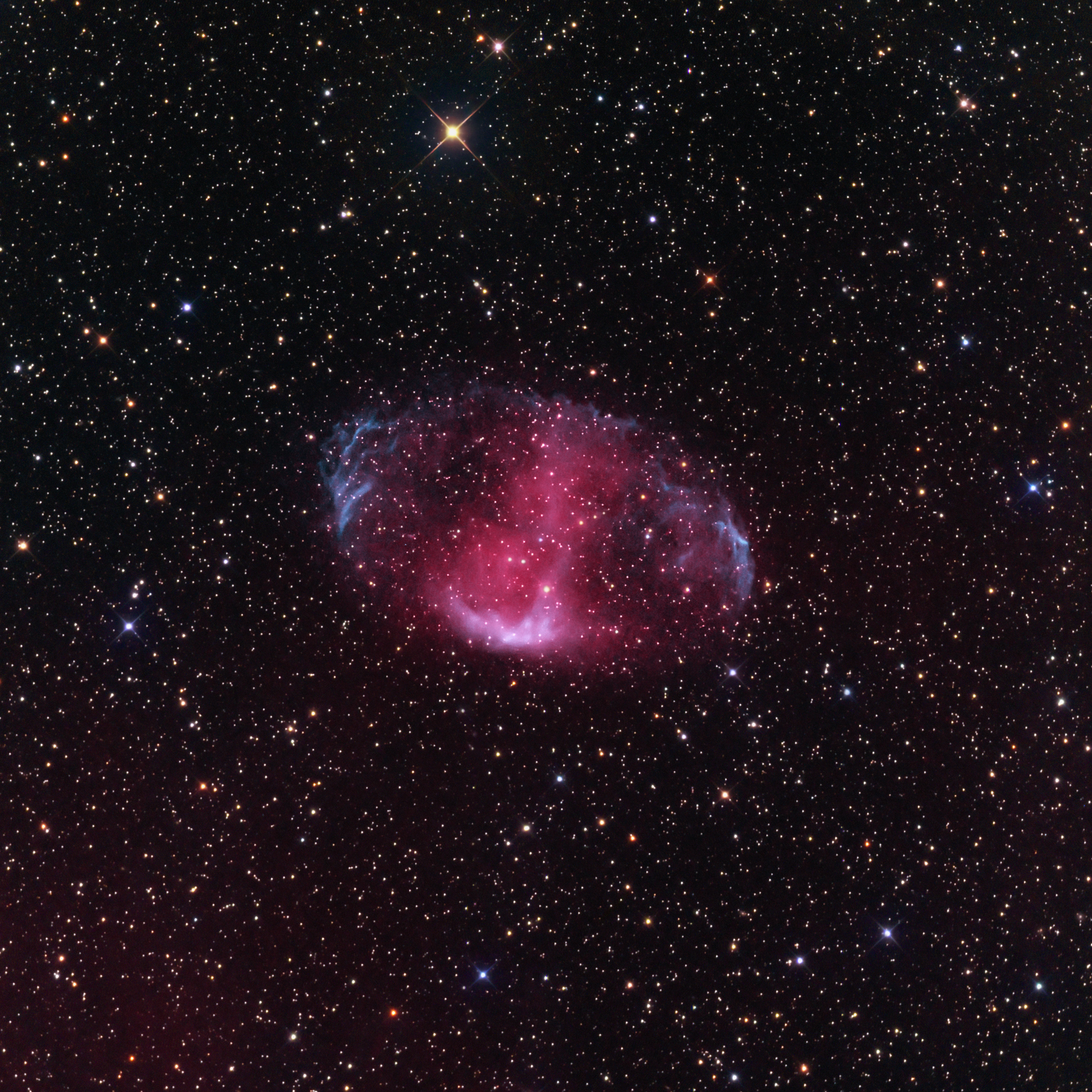
Stellar Evolution APOD: Methuselah Nebula MWP1
This picture features a planetary nebula at a distance of 4,500 light years away. Planetary nebula is one of the final stages of stellar evolution as the central star is shrugging off its outer layers to advance to a white dwarf and eventually cease of the life of the star. This particular nebula is one of the largest known with a diameter of nearly 15 light years and can be found in the constellation Cygnus the Swan. The average planetary nebulae typically last 10 to 20 thousand years but Methuselah Nebula has an age of 150 thousand years which has given astronomers great insight into the evolution of its central star. This star type is unique as you can physically see the star’s outside layers being shed in the pink and blue colored debris surrounding the central star.

Constellation Project:
Scorpius is one of the twelve constellations of the zodiac and is most visible in Washington in July and throughout the rest of the summer, can be seen by viewers located at latitudes of 42⁰ and above and is usually seen just above the horizon. Some of the five brightest stars of Scorpius are Antares, Graffias, Dschubba, Sargas and Shaula. The brightest star is Antares which is a red supergiant with an M1 spectral classification, an apparent magnitude of 0.9 and a distance from the earth of 520 light years. Graffias is the actually the sixth brightest star in this constellation though it is given the title of beta because of its position in the constellation and is actually the combination of two stars, Beta-1 and Beta-2. Beta-1 has a magnitude of 2.62 and Beta-2 has a magnitude of 4.92. Both stars in Graffias are 530 light years away which 2200 astronomical units apart, are class B stars and appear bluish-white to the eye.
The third star in Scorpius is Dschubba which is a spectral type B0.2 IV star, has an apparent magnitude of 2.29 and a distance of 400 light years. The fourth star is Sargas which can be found 270 light years away from Earth and has an apparent magnitude of 1.86 and is a spectral type F1II star. Shaula is the fifth brightest star in Scorpius and is a bluish-white star of spectral class B1 V, has an apparent magnitude of 1.62 and is 300 light years away from Earth. Some other objects contained in Scorpius include open clusters Messier 6 and 7 and globular clusters Messier 4 and 80 and the star U Scorpii which is the fastest nova with a period of around 10 years.
The third star in Scorpius is Dschubba which is a spectral type B0.2 IV star, has an apparent magnitude of 2.29 and a distance of 400 light years. The fourth star is Sargas which can be found 270 light years away from Earth and has an apparent magnitude of 1.86 and is a spectral type F1II star. Shaula is the fifth brightest star in Scorpius and is a bluish-white star of spectral class B1 V, has an apparent magnitude of 1.62 and is 300 light years away from Earth. Some other objects contained in Scorpius include open clusters Messier 6 and 7 and globular clusters Messier 4 and 80 and the star U Scorpii which is the fastest nova with a period of around 10 years.

Sunday, October 31, 2010
Sky Journel #5
October 18
Time: 5:45PM
Location: Eagle Drive, Burlington, WA
The weather was too bad this week to be able to see anything so I made it a point to watch the sunset instead. There isn’t much to say about it. It was pretty orange and pink in color and was at about 290⁰ West.
Time: 5:45PM
Location: Eagle Drive, Burlington, WA
The weather was too bad this week to be able to see anything so I made it a point to watch the sunset instead. There isn’t much to say about it. It was pretty orange and pink in color and was at about 290⁰ West.
Sky Journel #4
Date: October 12, 2010
Time: 1:30 AM
Location: Arbor street, Mount Vernon, WA
Time: 1:30 AM
Location: Arbor street, Mount Vernon, WA
The picture below is a replica I made of the sky as I saw it a couple nights ago (note that East is on the top, West the bottom, etc. because I was not facing North and this way is less confusing for me). The points have been drawn fairly large so that they’re able to be seen.
One constellation I think I saw was Auriga (labeled a on the “map”). Auriga has a really bright star as one of the points of its circle-like head which I was able to make out but I didn’t see any parts of the tail. The azimuth was about 40⁰ (northeast) and the altitude 15⁰.
Secondly, I thought I was looking at Cassiopeia (labeled b) but I often get it the larger W-shaped constellation confused with it. The azimuth was 350⁰ (northwest) and the altitude was 40⁰.
There were other stars out obviously but they were all pretty small and not very identifiable for me.

Sky Journel #3
Date: October 7, 2010
Time: 12:15 AM
Location: Arbor Street, Mount Vernon, WA
Time: 12:15 AM
Location: Arbor Street, Mount Vernon, WA
The picture below is a replica I made of the sky as I saw it last night (note that East is on the top, West the bottom, etc. because I was not facing North and this way is less confusing for me). The points have been drawn fairly large so that they’re able to be seen.
The most predominant constellation I could see was Ursa Major (labeled a) though I was not able to see all points of the constellation due to Washington’s infamous weather. The azimuth of Ursa Major from my location was about 350 ⁰ (north) and the altitude was about 40⁰.
The only other constellation that I was able to make out was what looked to be pieces of Cetus (labeled b). I was able to see most of the points of the smaller pentagon, the connecting star and the tip of the large pentagon-like shape. The azimuth of Cetus from my location was 180⁰ (south) and the altitude was about 40⁰.
In addition to constellations, I was able to see a fairly bright star which I though could possibly be the bright point on the constellation Cygnus (labeled c) which had an azimuth of 280⁰ (northwest) and an altitude of 65⁰.
Lastly, I saw another bright star close to Cygnus but I think it was too bright to be part of Cygnus and I determined it was a bright point of the constellation Lyra. This star had an azimuth of 285⁰ (northwest) and an altitude of 65⁰.

Saturday, October 23, 2010
Properties of the Sun Lab Write-Up
Problem: Use images of the Sun to find the rotation period of the Sun, and to find the velocity of matter leaving the Sun through a coronal mass ejection.
Hypothesis: It was my guess that we could determine the velocity of a coronal mass ejection because we had a way to determine distance and had photos that were representational of time but I figured our method would not give us the most accurate measurement as there is a fair amount of room for error.
Procedure #1: The following are the steps used for our first procedure: 1) we determined the diameter in pixels using the image of the sun. 2) We looked up the actual diameter and divided the actual diameter in km by the measured diameter in pixels and determined a km/pixel image scale. 3) We measured the distance in pixels that the coronal mass ejection moved and multiplied that number by our scale factor to determine the distance the mass ejection moved. 4) We used our calculations to determine the period of the sun in days.
Procedure #2: The following are the steps used for our second procedure: 1) we determined a new image scale by measuring the diameter of the sun in pixels and dividing the actual diameter of the sun in km by the pixel diameter. 2) We pinpointed both of the minimum heights in pixels of the mass ejections, used the distance formula to determine the pixel distance moved and then converted that number to km using our scale factor. 3) We pinpointed both of the maximum heights in pixels of the mass ejections, used the distance formula to determine the pixel distance moved and then converted that number to km using our scale factor. 4) We used our calculated distances to determine the change in height in km. 5) We used the times recorded below each picture to determine the time change. 6) We divided our calculated distance covered by the time it took for the mass ejection to move that distance and found the velocity of the material in km/h. 7) We converted our velocity to mi/hr.
Data & Calculations: Can be seen on the hardcopy of the lab which will be turned in on the day of the test.
Conclusion: We were able to determine the velocity of the coronal mass ejection using simple pictures, pixel measurements and formulas which was interesting. We determined that the material left the sun at an extremely fast velocity when compared to the velocity of things we are familiar with like cars and airplanes which is kind of mindboggling to think about. As with all labs there was some error in our calculations. This error came from unsteady hands used to determine pixel location as well as small photos that do not allow for very precise measurements.
Subscribe to:
Posts (Atom)