Tuesday, October 19, 2010

Satellite Motion Lab

Problem: This lab had two purposes: 1) to determine whether or not there is a relationship between the radius and period of a satellite’s orbit and if so, what that relationship is, and 2) to determine whether or not there is a relationship between the centripetal force and period of a satellite’s orbit and if so, what that relationship is.

Hypothesis: Prior to the execution of this experiment I did some brainstorming on what I already know about satellites. I knew that gravity keeps a satellite in motion and I knew that something becomes a satellite by being launched out into space at a high enough acceleration. I did not know the difference between a circular satellite and an elliptical satellite or the difference between centripetal and centrifugal force and finally, I did not know what role these forces play in satellite motion. My hypothesis for the outcome of this lab was that there is a relationship between the two sets of variables and constants but I did not really have an idea on what that relationship is.

Procedure: For this lab we did two separate experiments. For the first we kept the centripetal force constant and we changed the radius of the orbit five different times. For each new radius we tested the period three separate times and found an average of those three trials. For the second portion of the experiment we kept the radius of the orbit constant and changed the centripetal force five different times. For each new centripetal force we tested the period three separate times and found the average of those three trials.

Data:
 Period (s)
Radius (m)123Average
0.200.280.260.310.28
0.300.360.320.320.33
0.400.430.430.430.43
0.500.460.460.460.46
0.600.490.480.510.49


Sunday, October 17, 2010

Weekly Reflection 10/11-10/15

I found this week to be really interesting. I really have a very basic knowledge of astronomy so I thought learning the difference between comets, asteroids, meteoroids and the two types of planets was really interesting because I've always just kind of lumped the different items and debris in space into one big category. I also had a lot of fun with the satellite lab. I like really straightforward labs like that (hypothesis, procedure, create a table, collect data, conclusion). My aha moment was when you created the comet because it was cool to see it might actually look like. I don't really have any unclear moments from this week, I'm just glad to have a better knowledge of differences between different debris.

Monday, October 11, 2010

Weekly Reflection 10/4-10/8

I found the information this week to be pretty straight-forward. The information on waves was pretty much review for me but different laws (Wein’s and Stefan’s) were new information but easy to grasp. The majority of my time was spent finishing up the homework for this unit which I found to be fairly simple. I also found the lab to be interesting and easy. Finally, I felt pretty good about the test but I know I could’ve done better if I had spent more time preparing for it.

Friday, October 8, 2010

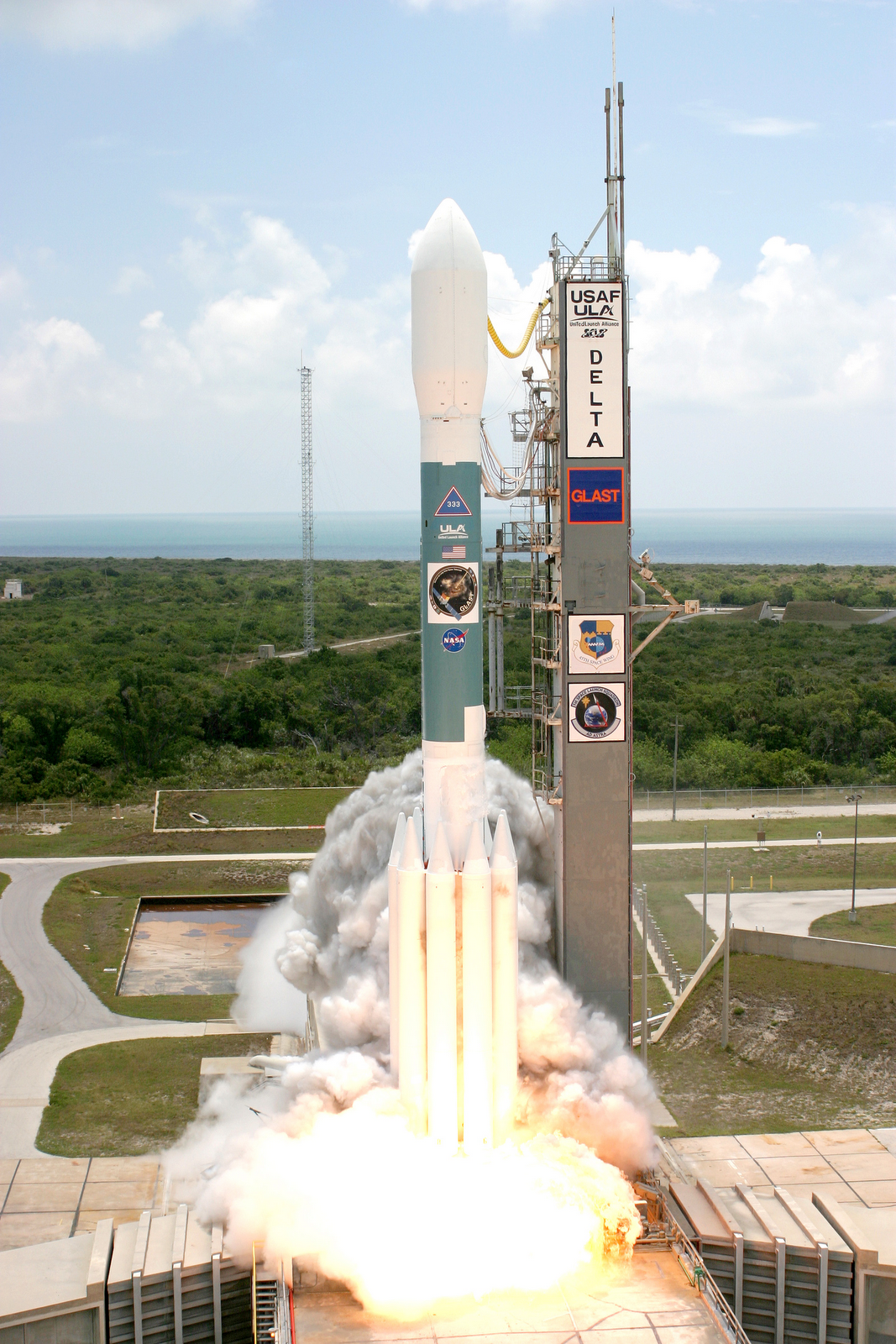
Telescope Research: Fermi Gamma-Ray Space Telescope

     The Fermi Gamma-ray Space Telescope was launched on June 11, 2008. It is a high-energy gamma-ray telescope that emits gamma-rays only in extreme conditions and it covers about 20% of the sky at all times, scanning continuously and covering the entire sky every three hours. The high-energy gamma-rays that Fermi emits cannot be refracted by a normal lens or mirror and instead are detected with technology used in high-energy particle accelerators. The emitted gamma-rays pass through a plastic anticoincidence detector and charged cosmic rays cause a flash of light which allows Fermi to detect the gamma-rays.
     From this point the detected gamma-rays then continue until they come in contact with an atom and produce an electron and a positron. The charged particles then create ions in thin silicon strip detectors which alternate in the X and Y directions allowing the particles’ progress to be tracked. Lastly, a cesium iodide calorimeter stops the particles and measures the energy deposited which allows physicists to estimate the energy and direction of the gamma-ray.
     Fermi was designed with three main missions in mind. The first was to explore environment out in the universe that are very different from Earth's environment. Secondly, it seeks to explore Dark Matter for other laws of physics and explain how black holes are able to accelerate objects to a speed almost as fast as the speed of light. And Lastly, Fermi was designed to understand gamma-ray bursts along with general longstanding questions. As far as discoveries to, Fermi was the first to detect gamma-rays from a nova which proved wrong the theory that novae are not able to emit radiation so high.


Monday, October 4, 2010

Weekly Reflection 9/27-10/1

                This week I spent a few hours doing the homework assignments from the book and didn’t find them to be too difficult. One thing I really disliked about this week and a bit of last week was the celestial sphere lab. I learned a lot from that lab but I felt like it would have been a lot easier if the sphere and how to line it up had been explained to us before starting the lab and if the directions were a bit more clear on which point we were looking out from when questions were asked. On the other hand, I found the scientific methods lab to be very easy because a lot of it was review from high school physics and chemistry and math comes fairly easily to me. One thing I really enjoyed this week was visiting the planetarium because it helped me see the sphere right in front of me.

Sky Journel #2

I went out on September 30th at 10:40 PM and this is what stood out to me most:


Scientific Methods Lab

Problem: Review five essentials of science: scientific notation, measurement errors and uncertainties, statistics, significant digits, and the scientific process.
Hypothesis: No specific hypothesis because of the nature of this lab but I expected to get a “brush up” on my knowledge of what constitutes a significant digit and how to express errors and uncertainties.
Procedure: We used a ruler and a scientific calculator to multiply numbers in scientific notation, estimated and measured distances and size, graphed statistics and found a line of best fit, and deciphered the amount of significant digits in a number.
Data and Calculations: Can be found on the hardcopy turned in on the day of the test.
Conclusion: The most beneficial portion of this lab for me was the section on significant digits as I was pretty familiar already with everything else in the lab.